


Root-End Resection (Apicoectomy) – When a Tooth Deserves a “Second Chance”
Sometimes, even high-quality root canal treatment is not enough to completely eliminate an infection at the tip of a tooth’s root. In such cases, a root-end resection (apicoectomy) may be the solution – a minor surgical procedure that can save the tooth and prevent extraction.
What is a root-end resection?
It is the precise removal of a small portion of the root together with the inflamed tissue in the surrounding bone. In this way, we can eliminate chronic infection and extend the lifespan of a tooth that would otherwise need to be removed.
Modern diagnostics and planning
Before the procedure, we always carry out:
-
CBCT (3D X-ray) – to see the exact position of the infection, the root, and nearby anatomical structures.
-
Digital tooth scan – used in the design of surgical guides.
At Madaras Dental, we routinely prepare 3D-printed surgical guides. These work much like laparoscopic surgery – allowing us to access the precise area with minimal removal of healthy bone. The result: faster treatment, less discomfort, and better healing.
When is root-end resection appropriate?
-
for chronic infections at the root tip that persist even after root canal treatment,
-
when the tooth is strategically important in a larger prosthetic work (e.g., bridge),
-
when repeating endodontic treatment is not possible or advisable.
How does the procedure work?
-
Local anesthesia is applied to numb the area.
-
A small incision is made to access the root tip.
-
The tip of the root and the inflamed tissue are removed.
-
Retrograde filling – the root end is sealed with a special biocompatible material (such as MTA) to prevent reinfection.
-
The wound is sutured, and healing begins.
Benefits of root-end resection
-
preserves your natural tooth,
-
faster recovery compared to extraction and implant placement,
-
high success rate with proper planning and modern techniques.
👉 At Madaras Dental, we combine the precision of 3D technology with a gentle surgical approach to save teeth that elsewhere might be considered lost.


Dental Implant – a Modern Solution to Replace Your Missing Tooth
Losing a tooth doesn’t have to be a lifelong problem. Thanks to dental implants, we can now restore not only chewing function but also the beauty of your smile – so naturally that you won’t be able to tell the difference between your own tooth and the replacement.
At Madaras Dental, we approach every implant case individually – with a focus on precise planning, maximum safety, and a natural, long-lasting result.
How is a dental implant placed?
1. Consultation and diagnostics
-
We take a 3D X-ray (CBCT) and a digital scan of your teeth.
-
This allows us to see exactly how much bone is available and where important anatomical structures are located.
2. Digital planning and 3D guide
-
Based on the examination, we design and produce a 3D-printed surgical guide.
-
This enables us to place the implant with millimeter precision – safely, quickly, and without unnecessary stress.
3. The implant procedure
-
The procedure is performed under local anesthesia, so it is completely painless.
-
We place the implant either:
-
immediately after tooth extraction, if conditions are favorable,
-
or into healed bone, if the site needs preparation first.
-
4. Bone augmentation (if needed)
-
If there is not enough bone, we can restore it with special grafting materials.
-
This creates the ideal foundation for the long-term stability of the implant. Healing usually takes 3–6 months.
5. Healing – open or closed
-
In some cases, we can leave the implant exposed (open healing) and even provide a temporary crown.
-
If conditions are less ideal, the implant is covered by the gum tissue (closed healing) so it can integrate quietly with the bone.
6. Final crown
-
Once the implant has healed, we place a highly aesthetic ceramic crown that blends seamlessly with your smile.
Should you be worried?
There’s no need for fear.
-
The procedure is carried out under local anesthesia, so you won’t feel pain.
-
Thanks to digital planning and 3D guides, the process is fast, safe, and minimally invasive.
-
After the procedure, you may experience mild swelling or sensitivity, which usually subsides quickly.
Why choose Madaras Dental?
✔ Modern diagnostics (CBCT + intraoral scan)
✔ 3D-printed guides for maximum precision
✔ Option for an immediate temporary crown in the aesthetic zone
✔ Painless treatment under local anesthesia
✔ Focus on natural beauty and perfect function
👉 If you are considering an implant, the most important step is the initial consultation. During this visit, we will determine the best solution for you and create a precise treatment plan – so you can smile with confidence again.

Non-invasive treatment of early approximal caries – we know how to do it
Early approximal caries is a problem that often goes unnoticed at first glance. Patients usually feel no pain, but on an X-ray it appears as a dark “shadow” between the teeth. In stages E1, E2, and D1 (caries limited to enamel or just into dentin), we no longer have to automatically drill. Thanks to the modern minimally invasive infiltration technique with the ICON Proximal system, we can stop these lesions and preserve the tooth completely without any tissue loss.
How does ICON infiltration work?
The principle is simple yet elegant:
-
Surface preparation – the tooth surface is treated with a special gel that opens the pores in the enamel.
-
Etching and drying – after rinsing, the surface is dried with ethanol to remove moisture.
-
Application of the infiltrant – a low-viscosity special resin (infiltrant) penetrates the porous enamel up to the caries boundary.
-
Polymerization – after light-curing, the infiltrant hardens and seals the enamel pores.
This halts the progression of the lesion, since bacteria can no longer spread deeper. The tooth remains intact, without drilling and without the need for a filling.

How long has the method been available?
The ICON system was introduced by DMG in 2009 and has since been successfully used worldwide. It has strong clinical documentation, and long-term studies confirm that it can significantly slow down or even completely stop the progression of early caries.
Results and advantages
-
Arrests caries without any loss of tooth structure.
-
Painless procedure, usually without anesthesia.
-
Esthetic effect – the tooth surface looks healthy, without white spots.
-
Prolongs tooth longevity, since no traditional filling is placed (which has a limited lifespan and needs replacement over time).
Disadvantages and cost
The main drawback is the higher cost compared to a conventional filling. This is due to the material and the technology involved. Nevertheless, it is worth it, because investing in your health and preserving natural teeth is always the best choice.
Conclusion
Treating early approximal caries with the ICON system represents a revolutionary step in dentistry – instead of drilling and filling, we can stop the problem completely non-invasively. Patients thus preserve their own healthy teeth without tissue loss and without the need for anesthesia.

What Is Normal After a Tooth Extraction and When Should You See a Dentist?
Tooth extraction is a common outpatient surgical procedure that usually goes quickly and without complications, although this is not always guaranteed. Patients often ask what is considered “normal” after the procedure and when it is advisable to see a dentist again.
How the wound heals
After extraction, there remains an opening in the gum and bone – the so-called extraction socket. It gradually fills with a blood clot, which is the foundation for proper healing.
-
Pain and sensitivity: mild to moderate pain in the first few days is normal and should gradually decrease.
-
Swelling: may occur, especially after more complex extractions or removal of wisdom teeth.
-
Whitish coating: this is not pus, but so-called fibrin – a natural protective layer that covers the wound and supports healing.
Important post-extraction care
-
Rest: avoid physical exertion on the day of the procedure.
-
Do not rinse your mouth: for the first 48 hours, so that the blood clot is not dislodged.
-
Eating and drinking: you may eat and drink, preferably avoiding very hot foods and beverages.
-
Oral hygiene: brush your teeth as usual, just be careful around the extraction site.
At Madaras Dental, we always clean and suture the extraction wound, which contributes to faster, higher-quality healing and reduces the risk of complications.
When to see a dentist?
-
if the pain does not subside or gets worse after several days,
-
if there is significant swelling or fever,
-
if you notice an unpleasant odor or taste from the wound (which may indicate dry socket or infection).
Think ahead – how to replace the tooth
Already at the time of extraction, it is wise to consider how you will replace the missing tooth. Every lost tooth affects:
-
chewing function,
-
stability of neighboring teeth,
-
the aesthetics of your smile.
Possible replacement options:
-
dental implant,
-
dental bridge,
-
prosthetic replacement.
Early planning will save you future problems and help preserve a healthy and functional dentition.
Why consider an implant at the time of extraction?
After tooth removal, the bone in the area naturally begins to resorb and lose volume. This process is most intense in the first months. If no replacement is planned in time, it may later require:
-
bone augmentation procedures (bone grafting or transplantation),
-
longer treatment,
-
higher costs.
Immediate options after extraction:
-
Immediate implant placement – in some cases, the implant can be inserted directly into the fresh socket. This saves both time and bone.
-
Socket preservation – if immediate implant placement is not possible, the socket can be filled with special material to slow down bone loss and maintain conditions for a future implant.
When both patient and dentist plan for future tooth replacement already at the extraction stage, the result is:
-
better healing,
-
improved aesthetic and functional outcomes,
-
shorter and simpler treatment.
👉 At Madaras Dental, we not only ensure smooth healing after an extraction but also guide you toward the most suitable tooth replacement option.

Periodontitis – the hidden enemy of your teeth
Many people think that if they don’t have cavities, their teeth are healthy. The truth is different – there is a disease that often progresses silently, without pain, yet can make even the most responsible patients lose their teeth. We are talking about periodontitis – a chronic inflammation of the supporting structures of the teeth.
Why is prevention so important?
Periodontitis begins subtly – with bleeding gums, slight swelling, or unpleasant breath. If not detected in time, the inflammation gradually destroys the tissues that hold the tooth in the bone. Seemingly healthy teeth, without a single cavity, begin to loosen and eventually fall out.
Regular preventive dental check-ups and professional dental hygiene are essential, as they allow for early detection of the first signs and stopping the progression of the disease.
The importance of personal oral hygiene
The best prevention is thorough daily oral care at home:
-
proper and regular toothbrushing,
-
using interdental brushes and dental floss,
-
supplementing with mouthwashes as recommended.
Without active cooperation from the patient, no professional can keep the periodontium healthy.
When is serious therapy necessary?
If the inflammation progresses deeper, regular cleaning is no longer enough. Sometimes, professional treatment of periodontitis is necessary, which includes:
-
deep cleaning of periodontal pockets (so-called scaling and root planing),
-
in some cases, surgical procedures,
-
local or systemic antibiotic treatment,
-
long-term regular check-ups and maintenance therapy.
Risk factors that accelerate the disease
-
Smoking – reduces blood flow to the gums and significantly accelerates tooth loss,
-
poor oral hygiene,
-
genetic predisposition,
-
systemic diseases (e.g., diabetes).
Why you should not wait
If periodontitis is neglected, the patient can lose completely healthy teeth – not because they decayed, but because they no longer have bone support. Subsequent treatment is complicated: prosthetic solutions are more difficult, implant placement is riskier, and the outcome is less predictable.
Conclusion:
Periodontitis is a hidden enemy that does not discriminate. It often affects people who believe they are fine because “they don’t have cavities.” Prevention, diligent oral hygiene, and timely professional care are the only way to keep your own teeth for a lifetime.

Jaw joint pain? It could be temporomandibular joint (TMJ) dysfunction
Maybe you know the feeling – you wake up in the morning with tight jaw muscles, pain around your ear when chewing, or a little “click” when opening or closing your mouth. All of these can be signs of temporomandibular joint dysfunction (TMJ) – the jaw joint that connects your lower jaw to your skull.
Why does jaw joint pain occur?
The causes are varied – sometimes stress and teeth grinding at night are to blame, other times it’s an injury, arthritis, or misaligned teeth. Often, several factors play a role at once, which means the exact cause may not always be clear right away.
Typical symptoms of TMJ dysfunction
-
pain around the jaw, ear, neck, or temples
-
limited mouth opening or a feeling of the jaw “locking”
-
clicking or popping sounds in the joint
-
headaches, dizziness, or ringing in the ears
-
a change in your bite or the feeling that your teeth don’t fit together as before
What you can try at home
The good news is that in most cases the condition improves over time without complex treatment. Helpful measures include:
-
gentle massage of the chewing muscles, warm or cold compresses
-
avoiding hard foods and chewing gum
-
consciously relaxing your jaw when stressed
-
simple relaxation techniques and breathing exercises
When to see a dentist
If the symptoms last longer, the pain is severe, or your jaw locks, it’s time to visit a specialist. At Madaras Dental we can help you with:
-
examination and precise diagnosis of your problem
-
creating a custom-made night guard to prevent teeth grinding, or a therapeutic splint that positions the jaw in a relaxed posture
-
recommending physiotherapy or special exercises
-
treatment with injections if necessary, or cooperation with maxillofacial surgery specialists
Why choose us?
Our goal is for you to feel relaxed and pain-free – not only during treatment, but also in your everyday life. We approach TMJ disorders with sensitivity and an individual treatment plan.
👉 If you are bothered by jaw pain or unpleasant “clicking” in the joint, don’t hesitate to contact us. At Madaras Dental, we’ll be happy to advise you and find the right solution together.

Demystifying Root Canal Treatment – Endodontics
Many people fear endodontic treatment (root canal therapy) and often assume it is painful or traumatic. The truth is quite the opposite – modern endodontics is safe, effective, and almost painless thanks to advanced anesthetic and technical procedures.
Anesthesia and Pain Management
At Madaras Dental, we always use local anesthesia, which effectively eliminates pain during the procedure.
In more complicated cases, such as with "hot" or acute teeth, anesthesia may be administered in two stages. To maximize patient comfort, we also recommend taking analgesics before and after treatment.
Basic Root Canal Procedure
-
Diagnosis – examination of the tooth and X-rays (periapical film or CBCT if needed) to visualize the root canal system accurately.
-
Local anesthesia – to completely numb the affected tooth.
-
Rubber dam – isolation of the tooth to ensure a clean, dry, and safe working environment.
-
Access to the root canal system – opening the tooth and exposing the canal entrances.
-
Working length measurement – using an apex locator to precisely determine the canal length.
-
Cleaning and shaping the canals – removing infected tissue and shaping the canals in preparation for filling.
-
End of the first appointment (in two-stage treatments, if needed) – application of a disinfecting intracanal medicament, temporary filling, and a control periapical X-ray.
-
Second appointment – filling the canal with a bioceramic sealer and gutta-percha cone, followed by a control X-ray and restoration of the tooth, such as an overlay or crown if required.
Modern Technique – Manualess Method by Dr. Amr Elwi
In our practice, we use the manualess technique, developed by Dr. Amr Elwi. The main principle is to maximize the use of rotary instruments instead of traditional manual filing:
-
Reduces treatment time compared to the classic manual approach.
-
Minimizes fatigue for the patient.
-
Increases precision and consistency in canal shaping.
This approach allows root canal treatment to be faster, safer, and more comfortable.
Conclusion
Root canal treatment is no longer something to fear. Thanks to modern anesthesia, rubber dam isolation, and advanced rotary instruments, root canal therapy can be painless and effective. At Madaras Dental, we prioritize comfort, safety, and modern technology to ensure your tooth remains healthy and functional for many years.

Oral Hygiene in Children: A Complete Guide for Parents
Oral hygiene in children is crucial for the health of both primary (baby) and permanent teeth, ensuring proper alignment of permanent teeth, jaw development, and the overall well-being of the child. Unhealthy teeth or early tooth loss can not only cause problems with chewing function and jaw development but also negatively affect a child’s self-esteem and psychological well-being. Establishing good habits from an early age protects against cavities, gum inflammation, and supports healthy oral development.
Tooth Eruption
-
Primary teeth usually start to erupt around 6 months of age.
-
The typical order is: lower central incisors → upper central incisors → lateral incisors → first molars → canines → second molars.
-
Permanent teeth begin to appear around age 6, with wisdom teeth emerging much later in adulthood.
Differences Between Primary and Permanent Teeth
-
Primary teeth are smaller, and their enamel and dentin are thinner and less mineralized, meaning cavities can spread faster.
-
Permanent teeth are larger, stronger, and more durable, but damage is more serious since these teeth are meant to last a lifetime.
How to Brush Children’s Teeth
-
Before the first tooth erupts, it is recommended to clean the gums with a soft gauze or a silicone finger brush – gently wipe after each feeding.
-
After the first tooth erupts, use a soft child-sized toothbrush.
-
Use fluoride toothpaste:
-
Up to 3 years – a rice-grain-sized amount,
-
3–6 years – a pea-sized amount,
-
Over 6 years – a regular amount.
-
-
Brushing technique: gentle circular motions, cleaning front, back, and chewing surfaces.
-
Adults should finish brushing children’s teeth until about 8–10 years of age (sometimes longer), until the child can brush effectively on their own.
Interdental Cleaning and Floss
-
In the primary dentition, spaces between teeth are natural and provide room for permanent teeth.
-
Dental floss or interdental brushes are needed once these spaces start to narrow, meaning when teeth begin to touch side by side, to prevent food from getting trapped and cavities from forming.
-
This typically occurs around ages 4–5, though the exact age may vary depending on the child’s tooth size and jaw development.
Types of Toothbrushes
-
Single-tuft toothbrush – ideal for isolated areas or erupting teeth.
-
Standard soft toothbrush – the gold standard for daily brushing.
-
Electric toothbrush – suitable from 3–4 years of age, helps clean hard-to-reach areas and increases children’s motivation to brush.
Preventive Check-Ups
-
Children should have dental check-ups twice a year.
-
OPG X-ray (panoramic) is usually done around age 6 to check the development of permanent teeth.
-
Bitewing X-rays may be taken earlier, especially if there is a risk of cavities in the back teeth.
Tips for Parents
-
Start cleaning gums before the first tooth erupts.
-
Be patient – children learn brushing technique gradually.
-
Motivate your child with games or songs during brushing.
-
Watch their diet – less sugar, more fruits and vegetables.
-
Ensure fluoride is included in toothpaste.

How to Take Care of Bridges and Crowns So They Last as Long as Possible
Crowns and bridges are among the most common dental restorations. They can restore chewing function, bring back the aesthetics of your smile, and significantly improve your quality of life. But to ensure they serve you well for many years, they require proper care.
Why is hygiene around bridges and crowns more demanding?
At first glance, cleaning bridges and crowns may seem the same as cleaning natural teeth. The truth, however, is that prosthetic work has specific areas where plaque and food debris tend to accumulate. These include:
-
the space under a bridge,
-
the margins of crowns,
-
hard-to-reach interdental spaces.
These spots are risk zones because poor hygiene can lead to gum inflammation, bad breath, and, in severe cases, damage to the supporting teeth or implants.
How to clean bridges and crowns at home
At Madaras Dental, we recommend a combination of several tools for the best results:
-
Manual or electric toothbrush – use gentle brushing to clean all surfaces of crowns and bridges.
-
Interdental brushes – in different sizes to reach every space, especially under bridges.
-
Superfloss or special dental floss – with a stiffened end that makes it easier to thread under bridges and clean areas where regular floss cannot reach.
-
Single-tuft brush – perfect for cleaning crown margins and areas close to the gums.
-
Oral irrigator (water flosser) – a useful addition to flush out food particles from areas a brush cannot access.
Important information before treatment
Before deciding on bridges, crowns, or other fixed prosthetic work, it’s essential to know that hygiene around prosthetic restorations is more demanding than hygiene around your own teeth. At Madaras Dental, we always make sure patients are aware of this in advance. This prevents disappointment later and prepares you for what’s needed to make your new teeth last long-term.
Professional care
Even thorough home hygiene cannot replace professional care. We recommend:
-
regular check-ups,
-
dental hygiene appointments every 6 months, or more often for high-risk patients.
During dental hygiene visits, we use modern and gentle methods – primarily airflow with special powders and instruments designed specifically for prosthetic restorations. These techniques effectively remove plaque and deposits without damaging crowns or bridges.
Summary
Crowns and bridges can give you a beautiful smile for many years. Their longevity, however, depends largely on you – how diligently you care for them at home and how regularly you visit your dentist and dental hygienist.
At Madaras Dental, we teach you the correct cleaning techniques and help you choose the right tools so that your crowns and bridges stay in excellent condition for as long as possible.
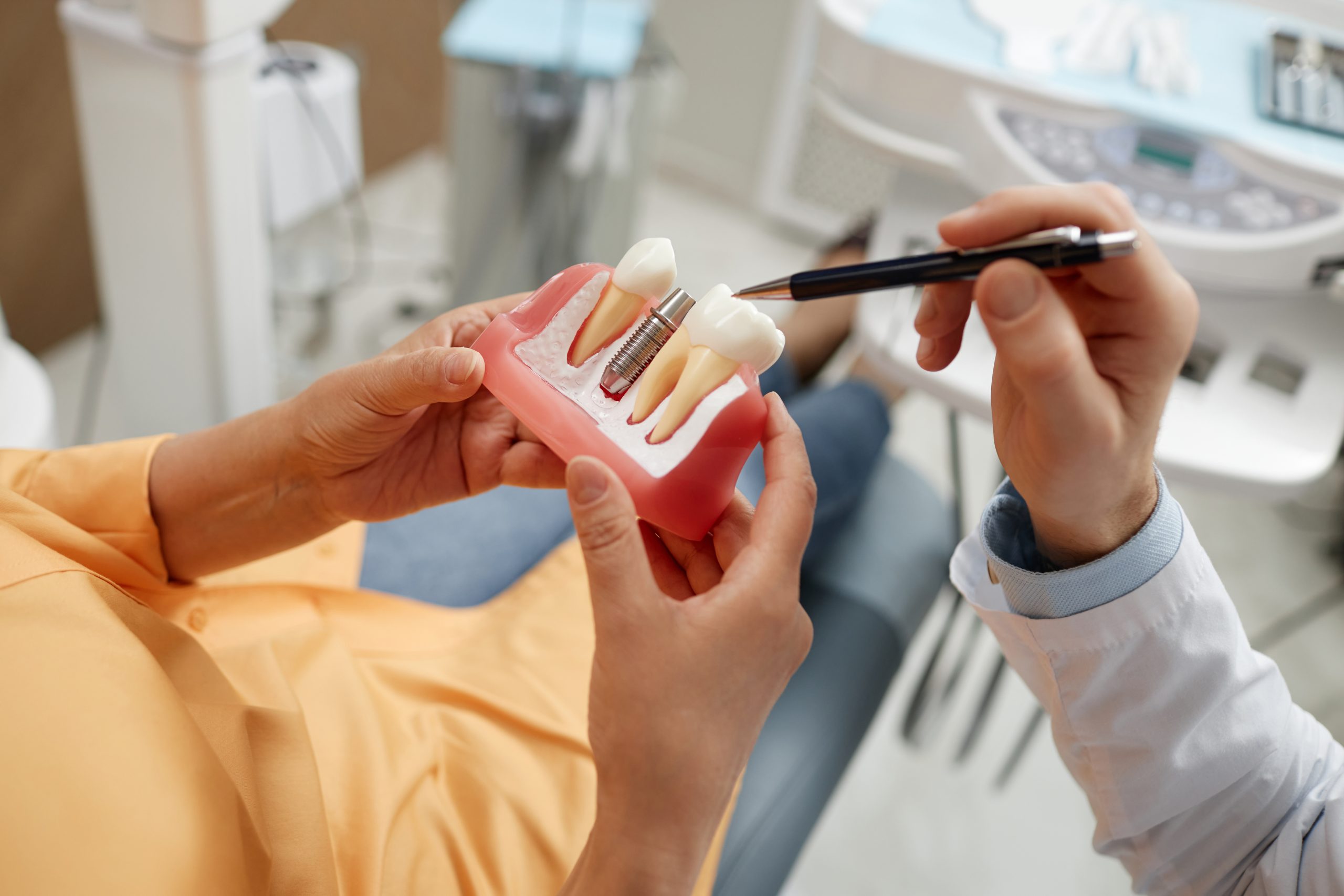
How to Take Care of a Dental Implant
A dental implant is a modern and reliable solution for replacing a missing tooth. However, to ensure it lasts as long as possible – ideally a lifetime – proper care is essential. Oral hygiene around an implant is slightly different from natural teeth and requires greater precision.
Why is implant care so important?
While the implant itself is a titanium screw that cannot decay, the soft and hard tissues around it are sensitive. Poor hygiene can lead to gum inflammation (peri-implant mucositis) and later even bone inflammation (peri-implantitis), which can cause the implant to loosen and fail.
How to clean an implant at home
Essential tools:
- Soft toothbrush – ideally sonic or electric with gentle bristles.
-
Interdental brushes – in different sizes depending on the spaces between teeth and implants.
-
Superfloss / special dental floss – designed for cleaning under bridges or around implants.
-
Alcohol-free mouth rinses – as a supplement for patients prone to inflammation.
Proper technique:
-
Brush at least twice daily with gentle circular motions.
-
Use interdental brushes daily – plaque most often builds up in interdental areas.
-
If you have an implant with a crown or bridge, pay special attention to the transition between gum and implant.
-
For multiple implants or bridges, use superfloss – its stiffened end allows easy threading under the construction.
How often to visit for professional dental hygiene?
We recommend:
-
Every 6 months – for most patients.
-
Every 3–4 months if you:
-
smoke,
-
have weakened immunity,
-
have multiple implants,
-
or have had inflammation around implants in the past.
-
Professional implant cleaning
The most effective and gentle method is Air-Flow® with a special subgingival powder (glycine or erythritol). This technology removes plaque even from hard-to-reach areas around implants and under bridges without damaging the titanium surface or ceramic/zirconia crowns.
Hand instruments and conventional ultrasonic scalers are used only rarely, in cases of hard calculus, and always with special tips designed for implants.
Detailed hygiene protocol (for larger reconstructions):
-
Single implant: subgingival Air-Flow® (main method); special ultrasonic tip only if calculus is present.
-
Bridges / larger work: ideally every 1–2 years, the prosthesis should be unscrewed, cleaned extraorally, and the implants/abutments cleaned with Air-Flow® or implant-specific ultrasonic tips.
The hygienist will also check the condition of the gums and instruct you on how to clean difficult areas around implants effectively at home.
What harms a dental implant?
-
Smoking – reduces blood supply to gums, impairs healing, increases risk of infection and implant loss.
-
Poor oral hygiene – the main risk factor for peri-implantitis.
-
Excess alcohol and sugar – encourage bacterial growth.
-
Bruxism (teeth grinding) – can overload the implant; a night guard is often recommended.
-
Skipping check-ups – small problems are easy to manage if caught early, but neglect can lead to implant loss.
Conclusion
Caring for a dental implant is an investment in its long-term success. Proper cleaning techniques, daily use of interdental tools, and regular professional hygiene are the keys to healthy gums and stable implants.
👉 At Madaras Dental, we not only provide implant placement but also ensure long-term care. During regular check-ups, we monitor not just the implant, but your overall oral health.